home maintenance
Home Maintenance List: Beginner's Guide
A beginner's home maintenance list for the year, including filters, alarms, and seasonal jobs, with official EPA and energy.gov habits you can actually keep.
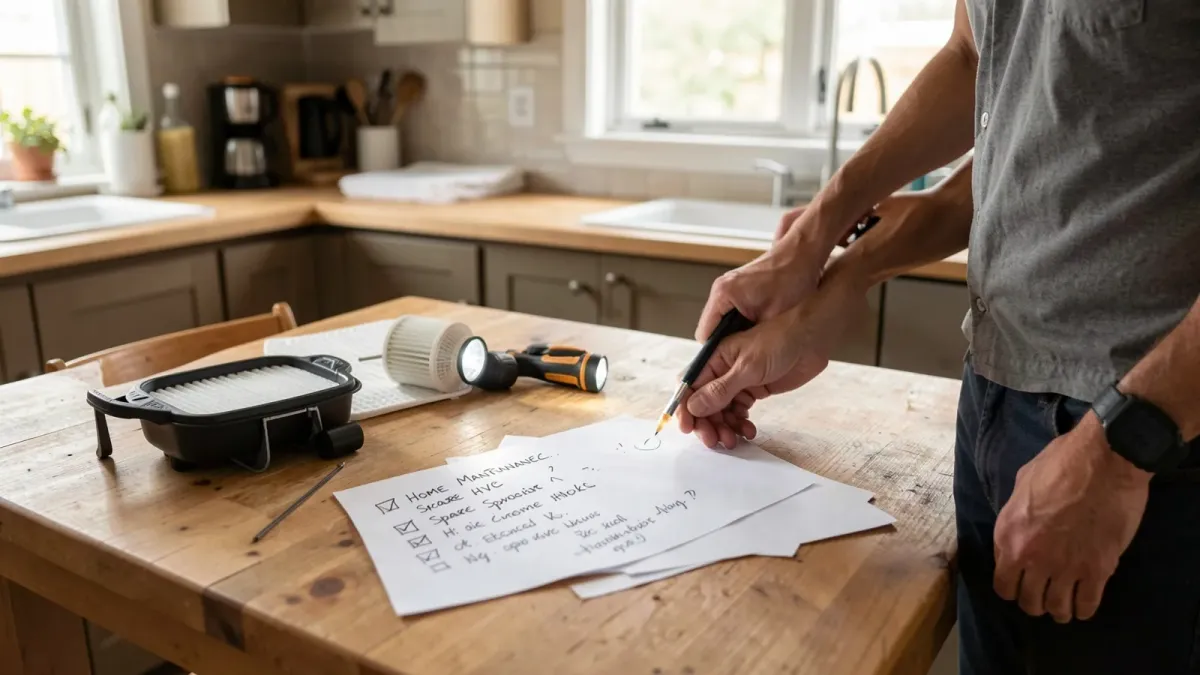
A home maintenance list is a calendar, not a scolding
A home maintenance list works when it lives on the fridge and gets a few honest ticks, not when it tries to turn you into a full-time caretaker of the building. Most houses ask for the same kinds of attention, year after year: clean or change filters, test alarms, look at the places water and air get in, and call a professional for fuel-burning equipment. The rest is noticing.
In our house, the list failed when it was a beautiful spreadsheet no one opened. It started to work when it became four short seasonal notes, plus a monthly alarm test on the same day the rent or the mortgage reminder already appears. You will forget a gutter in November once. You will remember it faster if last year's wet patch is still in your notes.
This is a beginner's map for a typical household, with official safety and energy habits woven in. It is not an inspection report, and it does not replace local codes or a qualified technician. If something smells like gas, if a carbon monoxide alarm sounds, or if you see active leaks into electrical areas, you stop and get help. A checklist is for the quiet work, not for an emergency.
A year on one page
Use this table as a starting list. Add the odd jobs your own house already taught you, and drop the ones that do not apply. A third-floor apartment will not have a garden hose bib; a house with a chimney will.
| When | What to do | Why it is on the list |
|---|---|---|
| Every month | Test smoke and carbon monoxide alarms; give HVAC filters a look and clean or replace them when they are dirty | The U.S. Environmental Protection Agency advises monthly alarm tests, and the Department of Energy includes filter care on its home energy checklist |
| Each year, at a memorable date | Replace alarm batteries unless the units have sealed 10-year batteries; look at the manufacture date and replace an alarm that is more than 10 years old | EPA winter indoor-air guidance uses this annual rhythm, and dated alarms do not last forever |
| Each heating season, before you need the system daily | Have a furnace, boiler, or heat pump serviced as the manufacturer and a qualified technician recommend; have fuel-burning appliances, fireplaces, and chimneys inspected and maintained | Energy.gov asks for yearly professional heating maintenance; EPA also advises annual professional attention for fuel-burning equipment and chimneys |
| When you first move in, and at intervals after that | Test the home for radon and fix a confirmed problem with a qualified mitigator | EPA calls radon a serious indoor-air risk and recommends testing |
| Autumn | Clean gutters you can reach safely, or hire the job; disconnect and drain outdoor hoses; check that the dryer vent still blows freely outdoors; walk the roof line from the ground | Leaves and early freezes cause a lot of the water problems people discover in January |
| Winter | Keep furnace, dryer, stove, fireplace, and radon vents clear of snow and ice; do not warm up a car in a garage; keep generators outdoors and well away from the building | EPA winter guidance is specific about blocked vents, garage warm-ups, and generator placement, including a distance of at least 20 feet from a building |
| Spring | Look for winter water stains, stuck windows, and grade or splash problems around the foundation; replace filters after a dusty heating season | Small stains are easier than a June surprise |
| Summer | Service or clean the cooling system as recommended; check weatherstripping; look at outdoor faucets, window screens, and any damp corners | Cooling filters and shade are energy jobs as well as comfort jobs |
Energy.gov also suggests a water-heater setting of 120°F on the warm setting, both to save energy and to reduce scalding risk, plus simple habits such as sealing the largest air leaks, insulating accessible hot-water pipes, and switching heavily used bulbs to LEDs. Those are worth a line on your own list. Official starting points are the Department of Energy's Home Energy Checklist and EPA pages on winter weather and indoor air and caring for your indoor air.
A beginner's checklist you can copy
- Smoke alarms are in the locations your local code and the manufacturer describe, and you can test them
- Carbon monoxide alarms are on each livable level, including a basement if you have one, and you know the sound they make
- HVAC filters are the right size, and you have a spare
- You know where the main water shutoff is, and you have actually turned it in your mind, if not with your hand
- Dryer lint is not a forgotten science project, and the vent terminates outdoors
- Fuel-burning equipment has a professional appointment on the calendar
- You have a radon test plan, or a result you have already acted on
- Gutters, downspouts, and the ground around the house send water away, not toward the wall
- A winter note exists about clearing vents and never running a generator indoors or in a garage
- You write down what you did, so next season is not a guessing game
If you rent, some of these jobs belong to the landlord, and some, such as testing alarms you can reach and changing a filter you are meant to change, may still be yours. The lease is the first document; official safety habits still matter.
How to keep a list without turning the weekend into a chore camp
Pick one monthly habit and one seasonal block. The monthly habit is the alarm test and a filter glance. The seasonal block is a single Saturday morning, or a hired hour, not a complete renovation. If a ladder is involved and you are not comfortable, hire the height and keep the ground-level jobs.
Keep products closed tightly, and ventilate when you use anything that can release fumes, as EPA indoor-air guidance recommends. "More bleach" is not a maintenance plan. Dry and clean will solve more ordinary problems than a new chemical.
A home maintenance list is also a memory of the house. The day you notice a soft spot on a sill, write it down even if you cannot fix it that afternoon. Future you, and anyone you later call for help, will want that sentence.
Questions about building a home maintenance list
What should be on an annual home maintenance list if I am just starting?
Alarms, filters, a professional look at heating equipment, a radon test if you have not done one, gutters or a hired gutter cleaning, a dryer-vent check, and a written note of the water shutoff. Add your house's quirks after the first year.
How is a winter home maintenance list different?
Winter adds blocked-vent checks, snow and ice around intake and exhaust, generator and garage habits, and a closer ear for equipment that sounds wrong in the first cold week. It is not a new house. It is the same house in harder weather.
Do I need a professional for every item?
No. Many tasks are looking, testing, vacuuming a vent you can reach, and changing a filter. Fuel-burning appliances, electrical work, roof work at height, and anything you do not understand are the usual reasons to hire someone licensed or otherwise qualified for that job.
Where can I check official advice instead of a random checklist on the internet?
Start with the Department of Energy home energy checklist and EPA indoor-air and carbon monoxide pages, then your local fire and building departments for alarm placement and permits. Official pages will not tell you which brand of filter to buy. They will tell you which habits actually matter.