3d printing
3d Prints for Home Organization: Beginner's Guide
A beginner's guide to 3d prints for home organization: measure first, choose a sensible load, and use a safety checklist before you print or hang anything.
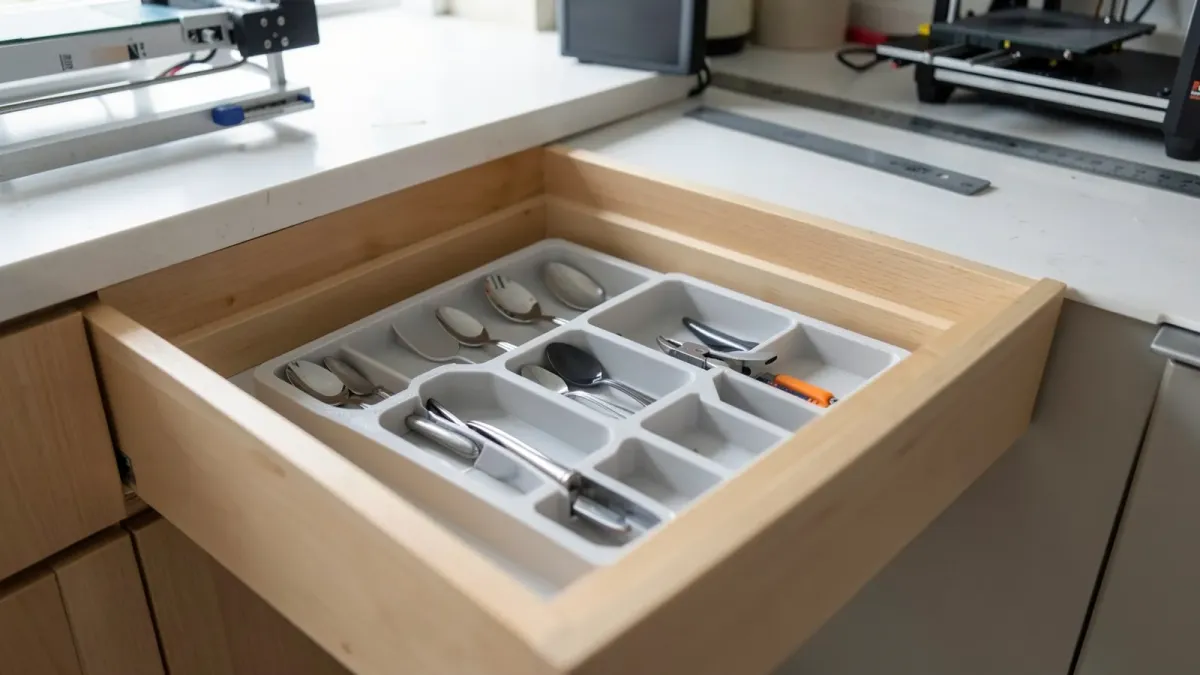
Measure the shelf before you print the gadget
3d prints for home organization are at their best when they solve a measurement you already have: a missing toothbrush stand that must fit a 40-millimeter gap, a bin that has to slide into a 120-millimeter drawer, a hook that must sit between two studs you can actually find. They are at their worst when they start with a clever file on a screen and end with a brittle object that does not fit, cannot carry the load, and now lives in a box of other almost-useful parts.
This is a beginner's guide to choosing and using printed organizers, not a review of printers or filaments, and not a set of invented product tests. You will see printer and filament names in shops. Treat them as labels. Compare the size, the intended load, and whether you can run the printer in a way that is kind to the room.
A printed object is still a plastic object. Do not assume it is food-safe, heat-safe, or child-safe because a file title said "kitchen." If a hook will hold a heavy bag over a hallway where people walk, think about what happens when the hook fails.
What a useful print actually has to do
Write the job down in ordinary units before you download or design anything.
| Job | What to measure | What to check in the design | A common disappointment |
|---|---|---|---|
| Drawer insert | Inside width, depth, and usable height, including slides and ramps | Wall thickness, drainage if it might get wet, and a way to remove the insert | A beautiful grid that is 3 millimeters too wide |
| Shelf divider or bookend | Shelf thickness and standing height; weight of the things it will hold | A wide, stable base; no sharp thin edges at child height | A tall, skinny divider that falls over |
| Hook, peg, or headphone hanger | Screw size or adhesive area; expected load; wall type | Real screw holes, not a suggestion of a hole; a shape that does not crack around the hole | An adhesive hook printed in a smooth plastic that lets go at 8 a.m. |
| Cable comb or plug holder | Cable diameter, outlet spacing, heat around adapters | Space around power supplies; no enclosure that traps heat around a charger | A tight sleeve around a warm adapter |
| Bathroom caddy | Bottle diameters, wet environment, cleaning habits | A design you can wash; rounded corners; no hidden pockets of standing water | An attractive lattice that stays damp and grows a smell |
| Label plate or QR mount | The exact width of the shelf edge or bin lip | Legible text size; a way to replace the label without reprinting the whole mount | Tiny lettering you cannot read in the cupboard |
If you cannot measure the space, you cannot yet commission the print, even if a neighbor owns a printer and is willing to help.
Safety, air, and the jobs a print should not be asked to do
Printers and melted filament can release fumes and particles. EPA indoor-air guidance, written for household products and appliances in general, still gives the right habit: ventilate when you use something that may release pollutants into the indoor air, and follow manufacturer instructions. Official starting points include EPA's Care for Your Air guide. Put a printer in a ventilated place that is not a child's pillow-side table, keep the area clean, and do not leave a first print unsupervised until you know how your machine behaves. Follow the printer maker's fire and placement advice; this article will not invent a clearance number.
Do not use a random printed container as a food-prep surface unless the material and the process are actually documented for that use. Do not store strong chemicals in a printed bottle that was designed as a toy crate. Do not hang a fire extinguisher, a heavy mirror, or a child's swing from a printed bracket because the file looked sturdy on a screen.
If children will handle the object, avoid small snap-off pieces and test the part the way you would test any toy: nothing that can break into a mouthable shard, no sharp edge at eye level. Official small-parts rules for young children are a reminder, not a decoration. For under-3s, objects that fit the CPSC small-parts cylinder are a problem; the test is in 16 CFR 1501.4.
A beginner's checklist before you print or order
- You have measured the space with a ruler or tape, not with a glance
- You can name the load: light accessories, or a bag you actually carry
- The design has a fastening method that matches your wall or drawer, not only a pretty shape
- You know what material you are using, and you have not assumed it is food-safe or heat-safe
- The printer will run in a ventilated place, away from bedding and unsupervised children
- You have a plan to test the first copy with a safe load, over a soft surface, before you trust it
- Wet rooms get a design you can dry and clean
- Chargers and lamps will not be wrapped in a tight printed shell that traps heat
- Failed prints have a box or a recycle path, so they do not become a second clutter problem
If a ready-made organizer already fits and costs less of your time, buying it is a valid organization choice. A printer is a tool, not an obligation.
How we use prints without letting them take over the house
The prints that stayed in our house were the unglamorous ones: a narrow tray that finally used a dead corner of a drawer, a simple hook plate with real screw holes, a set of identical cable clips. The prints that left were "clever" shapes that required everyone to remember a new ritual. If other people have to live with the object, design for a tired evening, not for a display.
Start with one object. Live with it for a week. Then decide whether to print a second. A house full of slightly wrong organizers is still a cluttered house, only more brittle.
Questions about 3d prints for home organization
Are 3d prints strong enough for home organization?
They can be, for light and moderate jobs, if the design, the material, the print quality, and the fastening method match the load. They are the wrong choice for hanging heavy or life-safety objects, and a first print should be tested gently, not trusted on sight.
What filament should a beginner choose?
Choose a material your printer is known to handle and that suits the room, following the manufacturer. This article will not invent a ranking. For a first organizer, many people start with a common, easy-to-print plastic and keep the object away from heat, food, and solvents until they know it better.
Can I print organizers for the kitchen or bathroom?
Yes, if you measure carefully and you can clean the shape. Keep printed parts away from open flames, hot pans, and the inside of a dishwasher unless the material is actually rated for that. In wet rooms, prefer open, dryable shapes.
Is it cheaper to print organizers than to buy them?
Sometimes, if you already own a printer and the part is a simple shape. Not always, once you count failed prints, time, and electricity. Count the job first. If a two-dollar tray already fits, the printer can stay off.